
Aprilaire Air Duct Cleaning in North Buffalo: A Homeowner’s Guide
Aprilaire equipment is precise by design. An ERV or HRV is built to exchange a measured amount of stale indoor air for fresh air, hour after hour. But that precision depends on clean supply and return ducts. In North Buffalo’s older housing stock, those ducts often carry decades of settled debris, and the Aprilaire unit ends up pushing clean air through a dirty pathway. This guide covers the specific intersection of Aprilaire systems and duct health: what a duct cleaning should actually involve, why sequence matters, and what to check on your Aprilaire hardware before and after. If you’d rather have this handled, call (877) 379-9769.
Key Takeaways
- Aprilaire ventilators and media air cleaners only perform to spec when the ducts they connect to are clean.
- Debris on duct walls raises static pressure, forcing the ventilator blower to work harder for less airflow.
- In homes with an Aprilaire media air cleaner, ducts should be cleaned before the filter is serviced or replaced.
- Aprilaire’s filter-change intervals assume reasonably clean ductwork; a loaded duct system will shorten filter life.
- North Buffalo’s cold, humidified winters can drive organic buildup inside ducts when moisture control runs high.
How does Aprilaire equipment interact with duct static pressure in North Buffalo?
Aprilaire ERV and HRV units move air through a small dedicated duct network and tie into your HVAC system’s return and supply. They’re sized for a specific airflow, measured in cubic feet per minute, at a specific static pressure. When debris accumulates on duct walls, the effective cross-section narrows and the friction increases. Static pressure climbs. The ventilator fan has to push harder to hit its rated airflow, and it usually can’t. What you notice at home is subtler than a breakdown: ventilation feels weak, the unit runs longer, and rooms that should get fresh air don’t cycle as well.
North Buffalo homes make this worse in a couple of ways. Many were built when ducts were sized generously but never sealed, so gaps already leak part of the pressure the system needs. Add years of accumulated dust, pet hair, and construction debris, and the Aprilaire unit is operating well outside the conditions it was designed for. In our experience, homeowners with Aprilaire ventilators often describe the same symptom: the unit runs, they can hear it, but the house doesn’t feel any fresher. That’s often a duct problem, not a ventilator problem.
What a technician should do before cleaning:
- Measure static pressure at the Aprilaire unit and at the supply plenum.
- Inspect the ventilator’s dedicated ducts and confirm the intake and exhaust are clear.
- Check the bypass damper position (see the dedicated section below).
- Note any flex duct runs that have collapsed or are pinched against framing, which mimics debris-related restriction.
What is the correct cleaning sequence for homes with Aprilaire media air cleaners?
Clean the ducts first. Service the Aprilaire filter second. It sounds obvious, but the order gets flipped more often than you’d think, and doing it in the wrong order throws away a filter and leaves you guessing whether the ducts are actually clean. If a media air cleaner is serviced before the cleaning, the aggressive agitation phase dislodges dust that immediately loads the brand-new filter. If it’s serviced after the cleaning, the filter starts its service life on clean air and gets its full rated interval.
Here’s the sequence we follow on any North Buffalo home with an Aprilaire media air cleaner:
- Isolate the Aprilaire unit and the media cabinet so debris isn’t driven into the cabinet.
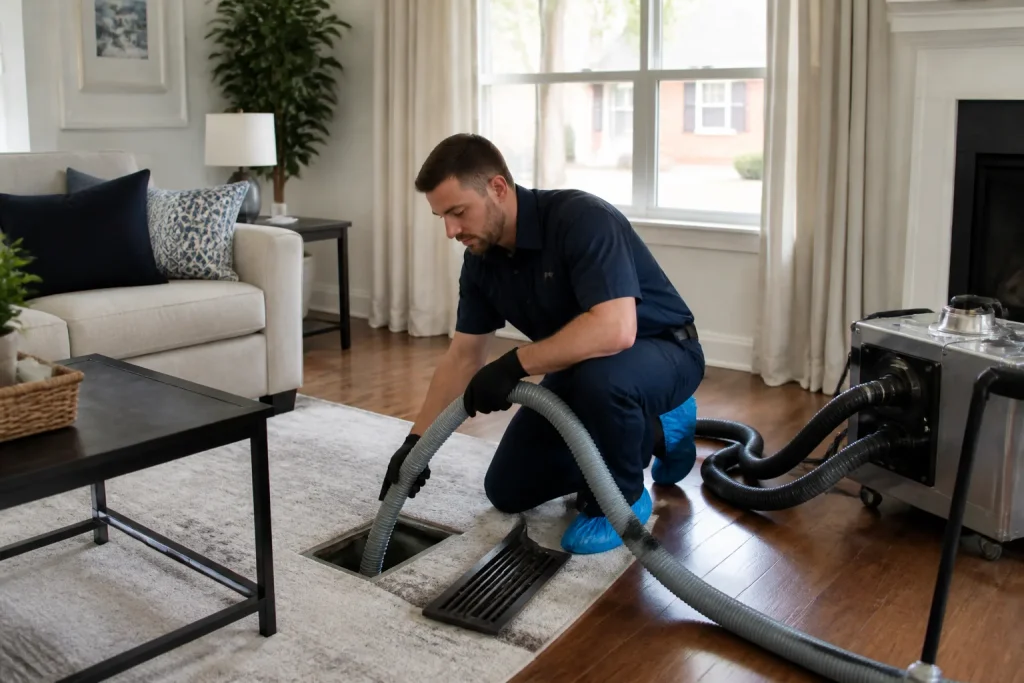
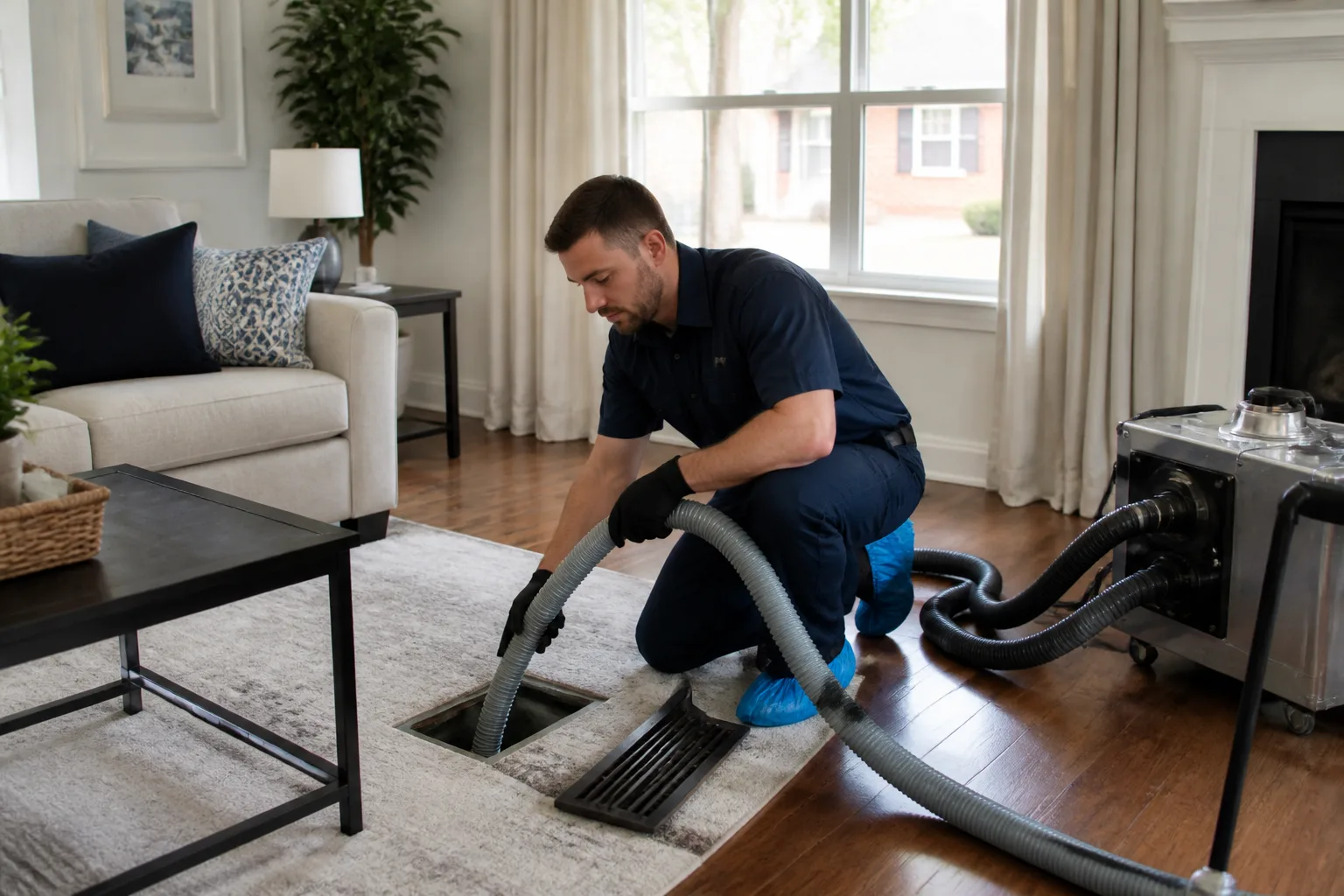
- Set up negative-air containment at the main return using a machine like a Nikro unit, which keeps dislodged material captured instead of drifting through the house.
- Mechanically agitate the duct walls with a rotary brush system, such as Rotobrush, then vacuum out the loosened material. Suction alone doesn’t break dust off a duct wall; agitation does.
- Run the supply side with the same agitation-and-capture approach.
- Run HEPA-style filtration through the work area, comparable to Abatement Technologies equipment, to settle airborne particles before the containment comes down.
- Only then open the Aprilaire media cabinet and service the filter.
- Re-measure static pressure and document the change.
The whole point is sequencing: agitation and capture happen while the Aprilaire downstream components are protected, and the filter only sees clean air. That’s the difference between a clean system and a filter that does its job correctly.
Why Aprilaire’s filter change intervals assume clean ductwork
Aprilaire publishes filter-change intervals based on normal household conditions and reasonably clean ductwork. Those intervals are a recommendation, not a guarantee, and they don’t account for what’s sitting in the ducts. A media air cleaner draws in whatever the return plenum delivers. If the return is coated in dust from years of accumulation, the filter loads faster than the manufacturer’s interval anticipates, and the “replace every X months” guidance starts running behind reality.
A few practical signals that your Aprilaire media filter is loading early:
- The filter has visible dust on the intake face well before the suggested interval.
- Static pressure across the media drops noticeably, or airflow to certain rooms weakens.
- The cabinet shows fine dust accumulation on the downstream side.
Rather than shortening the interval permanently, the better approach is to clean the ducts, then go back to Aprilaire’s standard interval. That returns the filter to the intended duty cycle. For a North Buffalo home with a heavy debris load, following an air duct cleaning visit, the next filter change is often the first one that behaves the way Aprilaire says it should.
North Buffalo winter humidity and organic buildup in ducts
North Buffalo winters run cold and dry, and a lot of homes run an Aprilaire humidifier to keep indoor humidity comfortable. That humidity control is genuinely useful, but it can also accelerate organic buildup inside ducts when the humidifier is overdelivering moisture into a system with dirty surfaces. Fine dust plus sustained humidity creates the conditions for microbial growth, especially in the cooler parts of the return network and in the ducts running through unheated spaces.
What we’d check on a North Buffalo home running an Aprilaire humidifier:
- Humidifier output versus the humidity setpoint on the controller. Overdelivering is common.
- Any visible moisture or dark discoloration inside return plenum surfaces near the humidifier injection point.
- Duct routing through unconditioned space, where surface temperatures swing and condensation is likelier.
Cleaning removes the food source. Then air sanitizing, using Guardsman-grade products, addresses residual microbial load on duct surfaces. Both are part of the same category of work, which is why we handle them under one service rather than splitting them across vendors: from dirty ducts to cleaner air, with the same team doing both ends of it.
What a technician should check on the Aprilaire bypass damper
The bypass damper is the part homeowners ask about least and technicians should check most. On an Aprilaire bypass humidifier, the damper controls how much air bypasses the humidifier pad. Its setting matters all year, and it should be verified before and after a duct cleaning. Before cleaning, a stuck or mis-set damper can mask airflow problems that look like duct restriction. After cleaning, the damper should be reset to its correct seasonal position so the humidifier performs as designed against the now-unrestricted airflow.
Before cleaning, confirm: damper is accessible, moves freely, and is in the correct seasonal setting; note the position so it can be restored.
After cleaning, confirm: damper resets to its proper position, humidifier is drawing correctly through the bypass, and the unit responds to the controller. Any change in airflow from the cleaning should be confirmed with the damper in its normal operating position, not taped open for convenience.
If the damper is seized, that’s a repair item, and it’s worth catching now. We seal what we clean, and that includes the small damper and boot connections around Aprilaire hardware.
When to call a pro
If your Aprilaire ventilator or media cabinet is behaving oddly and you can’t tell whether the issue is the unit or the ducts, it’s worth having someone measure. A static-pressure reading on both sides of the system answers the question in a few minutes, and it distinguishes a duct problem from an equipment problem. If you’ve noticed weak ventilation, a filter that loads early, or musty smells at the returns, that’s a call worth making. The same is true for HVAC cleaning, which covers the coil and blower assembly your Aprilaire gear depends on, and for dryer vent cleaning if you’ve never had the vent checked. Your dryer vent is a fire risk, and we treat it like one.
Related services in North Buffalo: air duct cleaning, HVAC cleaning, and dryer vent cleaning. You can see the full scope on our Air Duct Cleaning North Buffalo page.
The Bottom Line
Aprilaire equipment is worth owning, and it deserves ductwork that lets it do its job. Clean first, service the filter second, prove the result with a static-pressure reading, and confirm the bypass damper is where it should be. That’s the whole discipline. In North Buffalo, where older duct systems and humidified winters work against you, the sequence matters more than the brand on the box.
If you’re in North Buffalo and need help, Air Duct Cleaning North Buffalo offers free estimates. Our technicians have up to 9 years of experience, and we run professional-grade Rotobrush and Nikro systems with Abatement Technologies filtration on every job. Call (877) 379-9769. We answer 24/7, with fast dispatch from 7am to 7pm, Sunday through Friday.
Frequently Asked Questions
There’s no single interval, but a common starting point is every three to five years, sooner if you notice weak ventilation, dusty rooms, or a media filter loading early. Aprilaire’s recommended filter intervals assume reasonably clean ducts, so if yours are heavily soiled, plan a cleaning before the next filter change. Call (877) 379-9769 for a free estimate.
Usually, yes. Debris on duct walls raises static pressure and cuts effective airflow, which forces the ventilator to work harder for less ventilation. After a proper cleaning, static pressure typically drops and the unit returns closer to its rated airflow. The improvement depends on how much debris was present and whether any flex duct is pinched. Call for a free estimate and a static-pressure check.
After. Cleaning first keeps the new filter from loading with dislodged debris during the cleaning itself, and it lets the filter start its rated service interval on clean air. Servicing it before the cleaning wastes the filter and can mask whether the ducts were actually clean.
Not overnight, but sustained high static pressure makes the ventilator blower work harder than designed, and that strain adds up. A dirty system also loads the media filter early and can drive moisture-related growth when a North Buffalo humidifier is running hard. Cleaning and sealing the ducts is the maintenance that protects the equipment. Call (877) 379-9769 for a free estimate.
Written by the team at Air Duct Cleaning North Buffalo.
Need Air Duct Cleaning Help?
Call Air Duct Cleaning North Buffalo - the local pro we connect you with is licensed and insured, here with fast help in North Buffalo.
(877) 379-9769